
Kansas Busted Mugshots and Booking Photos
A mugshot is simply the photo taken during booking. In Kansas, the local sheriff or arresting agency builds that record. Some jails post names, photos, and custody status themselves. Nothing in state law forces every county to run the same public search, though. One county may publish a live roster with recent releases. Another leans on a brief report, a vendor portal, or a records-request path.
County and state records answer different questions. A booking photo tracks an arrest and jail intake. KASPER, run by the Kansas Department of Corrections, covers people sentenced to the Secretary of Corrections, including some on supervision or discharged. Neither record tells the whole court story. Later orders can also restrict disclosure.
The Atchison County Sheriff's roster page offers one example of a local entry point. It separates current inmates from a 48-hour release view. A disclaimer appears before the search itself. The local office controls that page and its retention, so its rules are not a Kansas-wide policy.
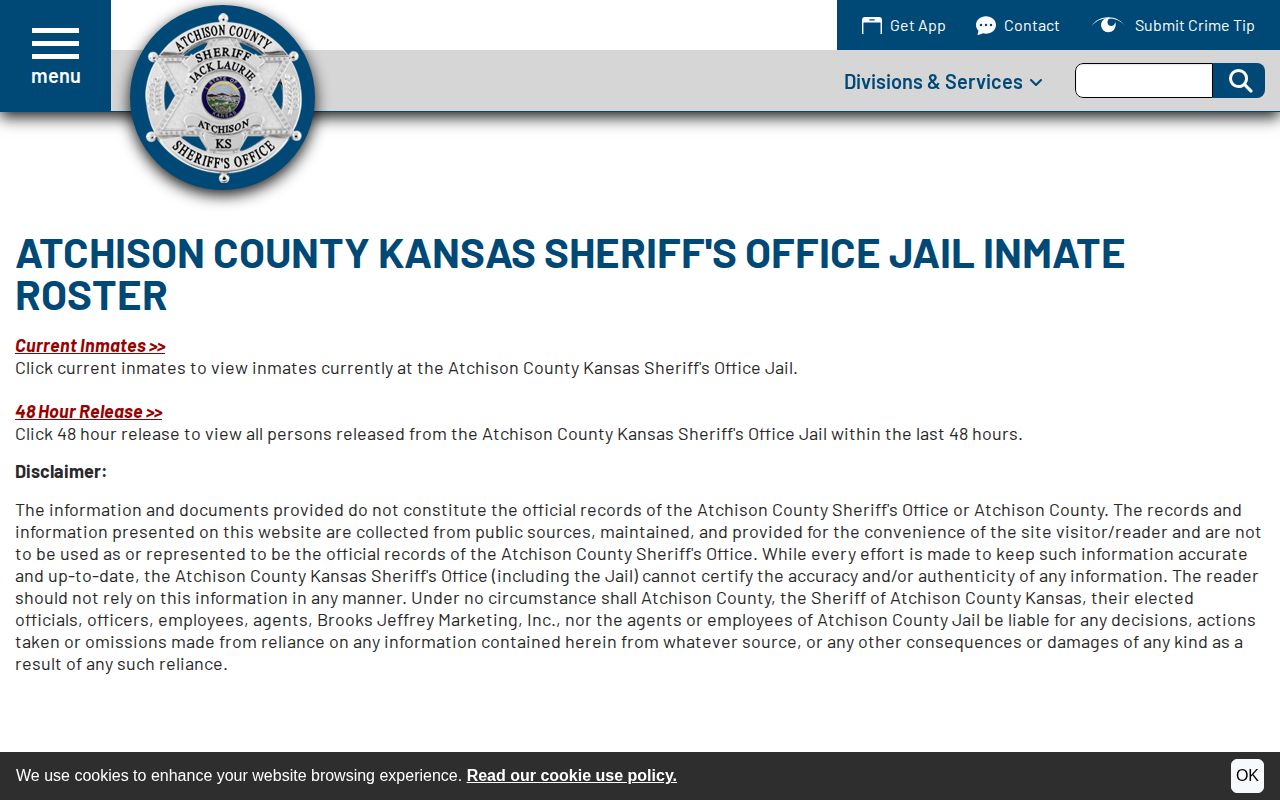
Other counties run similar gates. Fields, release windows, and photo rules differ from place to place, so check the county that made the arrest before treating any page as a current custody list.
What Kansas Busted Booking Records Show
No single booking form serves all 105 Kansas counties. Each local roster shows whatever fields the sheriff and vendor picked. KORA can get you an existing booking record. It cannot make a custodian build a new statewide report or answer a research question. The chart splits common county-facing fields from the broader KDOC profile fields the state agency describes. Keep the two layers separate.
| Stage or record field | Where to check | What the source may show |
|---|---|---|
| Just booked | County roster or feed | A local intake entry, with a photo only if that county publishes one. |
| In county custody | Current jail roster | A current status at the time checked. The portal may drop the entry after release or transfer. |
| Released from county jail | Recent-release view or agency record request | A short public window where offered, then the existing booking record held by the agency. |
| Sentenced to state custody | KDOC KASPER | A corrections profile that can include a photo, state number, conviction and custody details. |
| County roster: name and date | Sheriff or jail portal | The name and booking or arrest date attached to a current or recent entry. A name match is not proof of identity. |
| County roster: status and photo | Sheriff or jail portal | Custody or release status and a booking image only where local policy allows one to appear. |
| County record request | Arresting or holding agency | The record actually kept may include a booking number, arresting agency, charges as booked, bond details, or related documents, subject to exemptions. |
| KDOC: name and KDOC number | KASPER profile | The identity and state corrections number used to distinguish the offender entry. |
| KDOC: photo and physical description | KASPER profile | An offender image and physical-description fields, with photo-date limits explained in the system disclaimer. |
| KDOC: case, custody, and supervision | KASPER profile | Conviction crimes, county and case details, status, location, anticipated release, parole-office information, and movements where present. |
KASPER is not an arrest history. Read each profile with its status and date rather than treating it as a live jail roster.
Kansas Mugshot Law and KORA
Kansas rests on the Kansas Open Records Act rather than any statewide mugshot-publication mandate; K.S.A. 45-216 states the policy. Sections 45-218 through 45-220 cover requests, responses, costs, and procedures. K.S.A. 45-221 lists exceptions. It calls for separating open material when practicable. The criminal-investigation exception turns on the record and the circumstances, so it neither hides every arrest record nor requires every photo online. The current Kansas statutory chapter holds the full text.
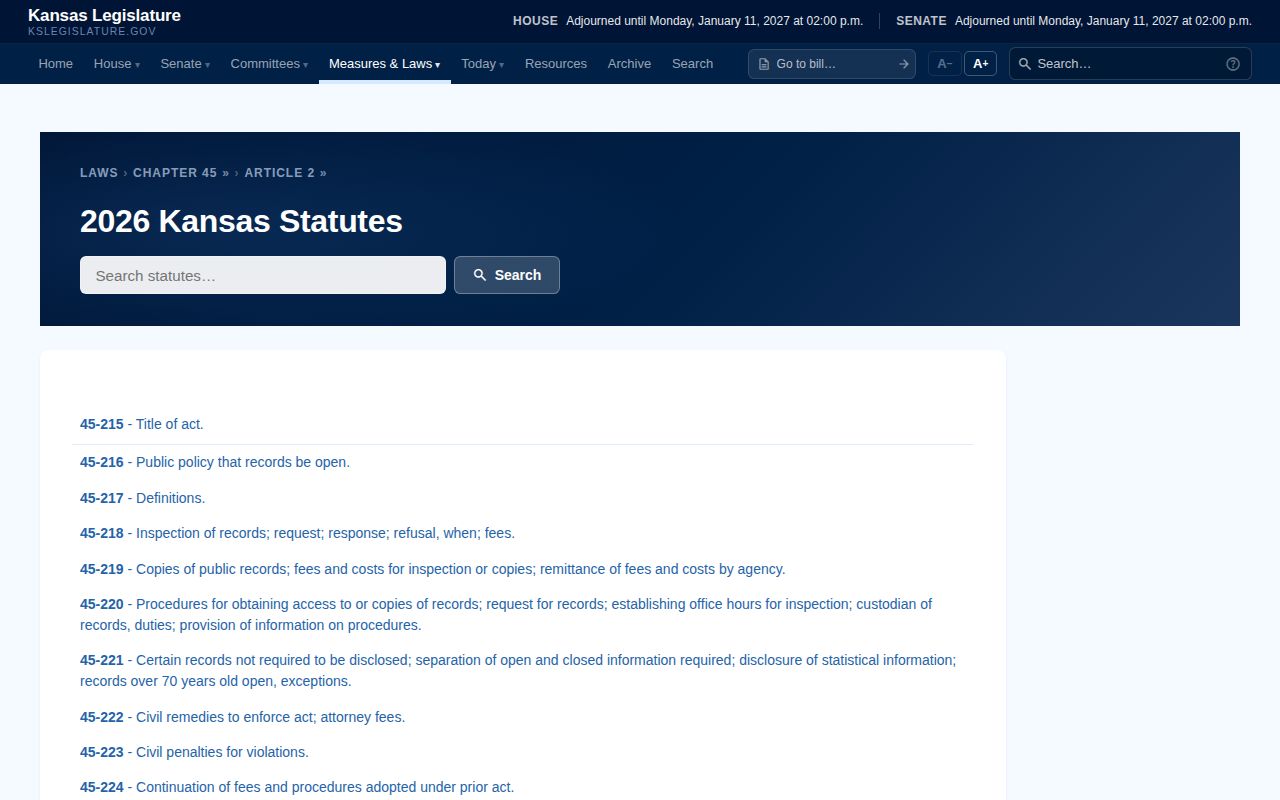
Kansas treats a jail roster or basic blotter differently. A standard arrest report or booking photo is another matter. Attorney General opinions draw those distinctions. The real answer is narrower than "all Kansas mugshots are public." Availability depends on agency policy. The particular record matters too. Investigative concerns, juvenile rules, protected identities, or a court order can also matter.
Kansas has no mugshot-specific pay-to-remove statute. That gap is not a green light for every private publication site. Privacy, defamation, consumer-protection, and expungement rules can still apply. A public source and an unrestricted right to republish every field are two different things.
Request Kansas Booking Records
When no web roster shows the record, ask the agency that made the arrest or holds the person. A Kansas open-records request seeks an existing record. It does not create a new list or an explanation. The county directory routes you to the local site. The sheriff or police can name its custodian. You can ask to inspect, get copies, and have open parts separated from exempt material.
- Name the arresting or holding agency and the county. If the county is uncertain, start with the arrest location and confirm which jail received the person.
- Give the person's name and an approximate booking date. Add a booking number only if a source already supplied one.
- Describe the specific existing item, such as a booking sheet, a release record, or a booking photo. Ask for a copy or inspection and say which format works.
- Ask the custodian to identify the legal basis for a denial and release any reasonably separable, non-exempt part. The agency can charge reasonable actual costs.
- Allow the agency to respond within three business days or explain when it expects to answer. That is a response deadline, not a guarantee that the record itself arrives within three days.
KDOC routes its records through the agency's own KORA process, including an online request portal, per the state brochure. Name the existing profile you want. Do not ask for a newly built statewide photo database. KDOC flags access limits on security, supervision, medical, and criminal-investigation records. Reasonable actual costs may apply. One search often needs two custodians. The county holds the arrest and booking layer, while KDOC holds state-corrections data after a sentence to the Secretary of Corrections. The court clerk holds the docket. A transfer changes the office, not the booking record.
Kansas Busted Records After Court
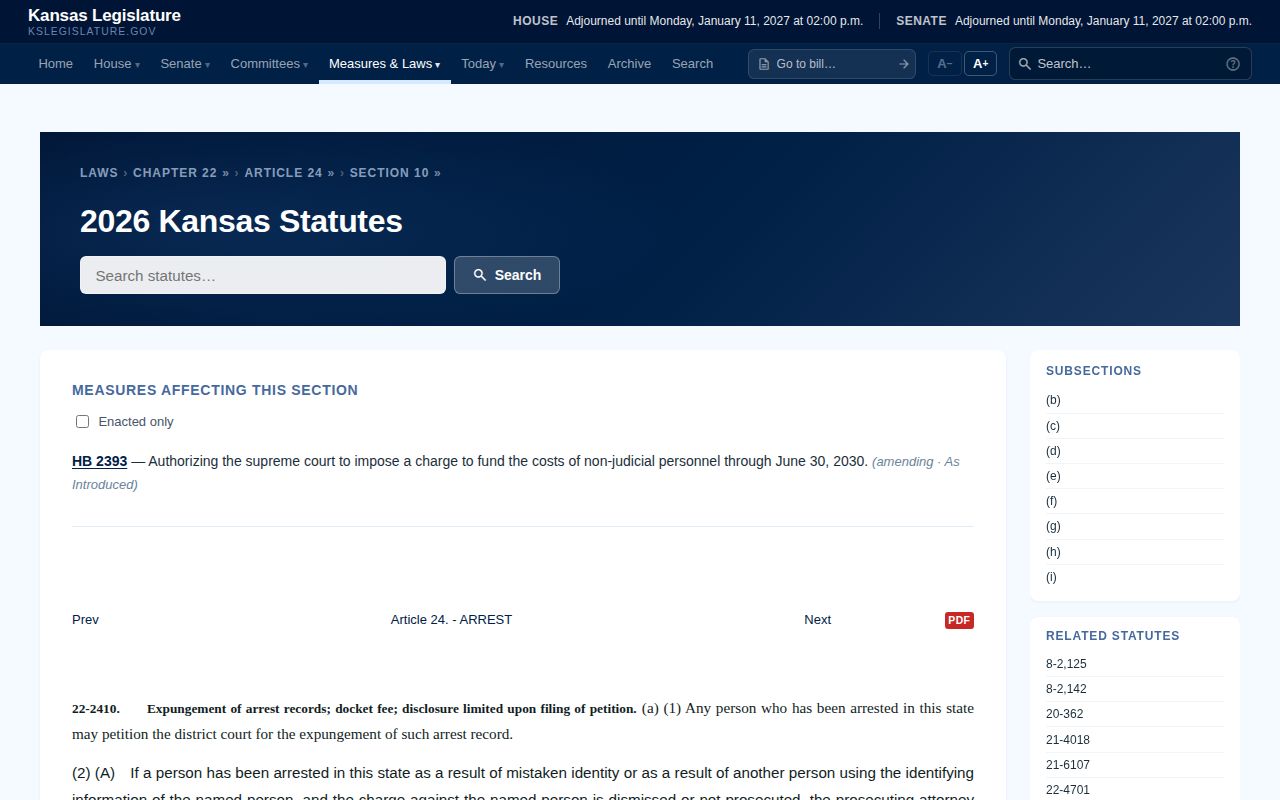
An old booking photo can outlast its case. Cases end in different ways, and dismissal, acquittal, diversion, expungement, and conviction each carry distinct consequences. K.S.A. 22-2410 lets a person arrested in Kansas petition to expunge the arrest record under listed conditions. K.S.A. 21-6614 covers conviction and diversion records. Its waiting periods and exclusions vary by offense. The offense and any later obligations shape what qualifies. The Legislature's current text for arrest-record expungement spells out the petition and the disclosure limits that follow an order, so read it with the court forms and a lawyer's advice.
Juvenile cases live under different statutes. K.S.A. 38-2309, 38-2310, and 38-2312 control them. That means a juvenile name or image pulled from a vendor page or social post cannot be handled by adult rules. Kansas's 2026 automatic-expungement proposal never became law, so the petition framework described here still sets the baseline.
Kansas Busted Mugshot Corrections
A court order gives you standing to act. Contact the agency first, then each republisher, with the exact record and the court document in hand. Be clear about what an order does. Old copies can still linger online. Busted Newspaper's free request asks for identifying details, the exact page URL, a reason, and supporting documentation. RecentlyBooked's no-charge policy covers dismissed, expunged or sealed, incorrect or outdated, wrong-person, juvenile, and duplicate records. Accurate current public records may not qualify. Mugshots.com also describes free qualifying updates, tied to its own categories, proof requirements, and review. None of this is a Kansas removal law. No publisher promises that every accurate public record comes down.
Arrests.org and Mugshots.zone offer no free removal route for their Kansas pages. Neither publisher posts one. Save the exact page address and pull the docket or order. Then use each publisher's current contact or correction path. A request is not a guarantee. And skip anyone demanding a fee to erase every copy. The statewide law guide separates an original agency record from a changed disposition, an expungement order, and a republisher's policy.
Find Kansas Busted Mugshots
Start with the place and date of the arrest. Then follow the custody trail. A county roster gives a fast answer for someone currently held or recently released, though the entry can vanish after a short window. When nothing shows online, the records custodian comes next. A court docket can reveal later events, and KDOC remains the state-prison path.
- Identify the county where the arrest happened and open that county's official roster or jail page. Read the agency's disclaimer and note whether the page covers current inmates, recent releases, or both.
- Search the name and any available booking number or date. County tools vary, so try the portal's own field labels and confirm a possible match with another source.
- If the local page is text-only, offline, or too brief, ask the arresting agency for an existing booking or release record under KORA.
- If the person was sentenced to state custody or is on state supervision, check KDOC's KASPER offender search and read its warning about coverage and photo dates.
- Use the Kansas court portal or clerk for the case outcome. A jail entry is not the final disposition.
This sequence separates a fresh booking from a past arrest, a state-prison profile, or a court record. Emergencies are different. If there is an immediate threat, call 911. Never approach a wanted person or treat a database match as authority to detain anyone.
Where Kansas Busted Mugshots Appear
Begin with the official record itself. Any outside copy is just a lead. Match the name, date, and record type against the source before you treat it as current.
| Source | Photo or record? | How to read it |
|---|---|---|
| County sheriff or jail | Roster, booking entry, or photo where published | Best first source for a local booking; coverage and dates vary. |
| Agency records request | Existing booking, release, or related record | Ask the arresting or holding custodian under KORA. |
| KDOC KASPER | State corrections profile and photo | For sentenced state custody or supervision, not a complete arrest history. |
| Kansas courts | Case docket and public documents | Use it to check proceedings and disposition, not jail custody. |
| BOP or ICE | Federal or immigration custody location | Locator results do not promise a public mugshot. |
| Busted Newspaper | Secondary booking material | Partial coverage can lag the responsible agency. |
| RecentlyBooked | Secondary recent-arrest pages | Its visible county set and time window can change. |
| Mugshots.com | Secondary and historical index | An older item may not show later court events. |
| Arrests.org | Selected county booking cards | Coverage is not statewide or complete. |
| Mugshots.zone county pages | Secondary county pages | These are not sheriff records and can change. |
The first five rows identify official record holders; confirm third-party entries there.
Kansas County Roster Patterns
Kansas runs booking rosters county by county. There is no shared vendor and no statewide feed. The 105 counties mix every format imaginable: searchable photo portals, active-inmate lists, released-inmate tabs, PDFs, weekly reports, VINE links, phone directions, and KORA requests alone. A county missing from an aggregator menu still keeps official records.
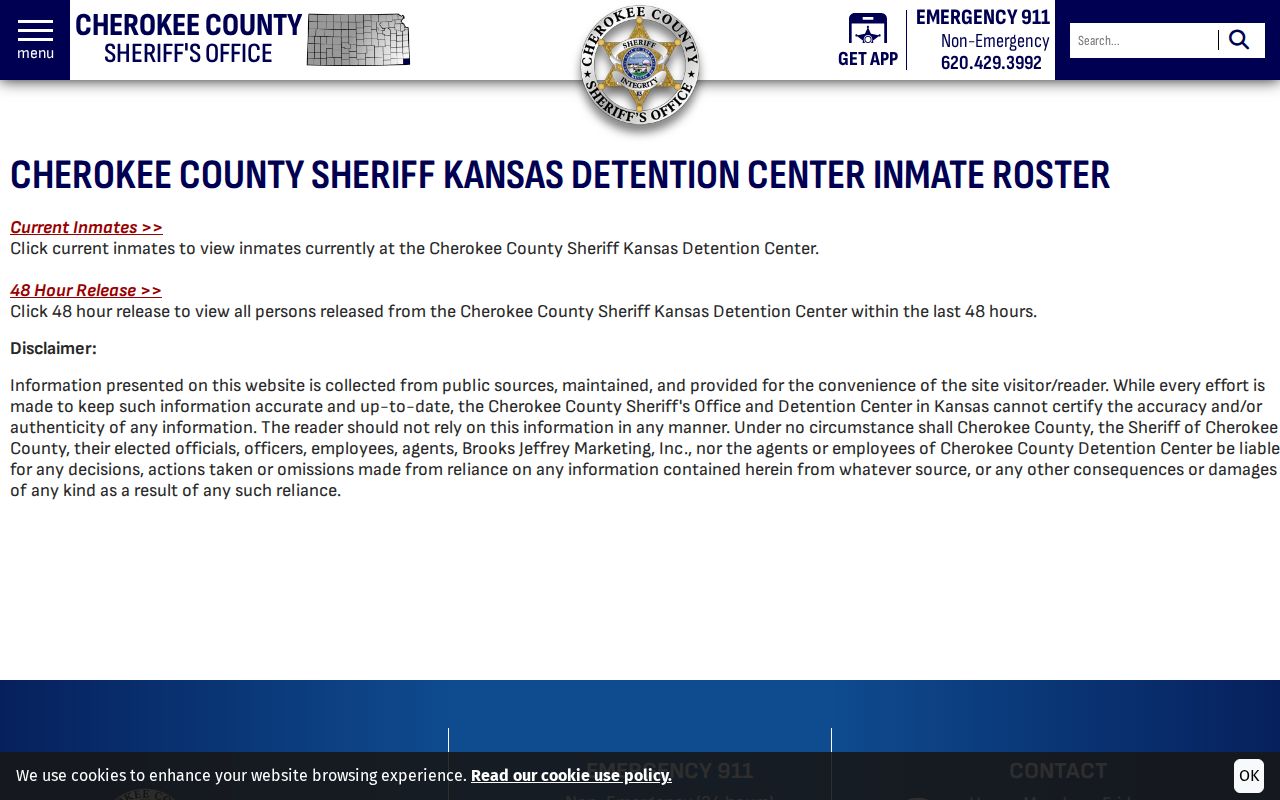
Some counties show photos with bookings. Atchison lists current inmates plus a 48-hour release view. Cherokee opens its roster with a disclaimer, and that disclaimer page spells out the current and recent-release routes before you search. Kingman keeps a local current-inmate page. Chase and Dickinson lean on vendor-style searches. Every layout, field set, and date range is a local choice. A familiar vendor look does not add up to one statewide policy.
Plenty of counties take other paths. Some list names with no photos. Some post a dated PDF. Some point to VINE, and some publish no web roster at all. A missing page is not proof of a missing jail record. It only means the records live offline. They sit behind a phone call, or behind a written request. The broader pattern: larger counties tend to run vendor-backed searches. Rural counties lean on short reports or direct contact. Treat that as a tendency, not a rule.
Kansas County Search Fields and Alerts
Search portals can filter by name, booking number, custody status, or dates. The controls differ everywhere. Nothing about a filter proves the county collects identical data.
Alerts are a separate matter. Sheriffs sometimes push detention updates through an app or social posts. Atchison County's app page is one official example. Yet an app can carry alerts while the county posts no web roster at all. No app covers every Kansas county. Follow each county's own link. Never mistake an alert feed for a full booking record.
When Kansas Busted Feeds Update
Update windows are local. One county may list current custody, while another keeps a short recent-release tab like Atchison's 48-hour view. Elsewhere the public option may be a historical search, a daily file, a dated PDF, or nothing at all. No statewide posting hour exists. No update guarantee covers every county.
Weekends, transfers, data entry, court orders, and vendor outages can all widen the gap between an arrest and a roster entry. A result can vanish when custody ends. The agency may still hold the booking record even then. A recent list is not a full case history, and an old third-party archive does not prove anyone is still jailed.
When a feed is late or missing, ask the arresting or holding office for its record. For a court event, use the docket or the clerk; for a later state sentence, move to KDOC. Keep each date label as the source presents it. Never call every old result "recent."
KASPER Photos for State Prisoners
KASPER stands for the Kansas Adult Supervised Population Electronic Repository. KDOC says it covers people sentenced to the Secretary of Corrections since 1980. They may be incarcerated, on post-incarceration supervision, or discharged. Updates run each working day, minus weekends. Interstate-compact holds are left out. It is not a full Kansas arrest history. Someone sitting in a county jail before sentencing may not appear at all.
The KASPER disclaimer tells users not to treat the data as a complete criminal history. It is not a reason to arrest anyone. It also flags that a photo date shown on a profile may come from the database. The day the image was taken may differ.
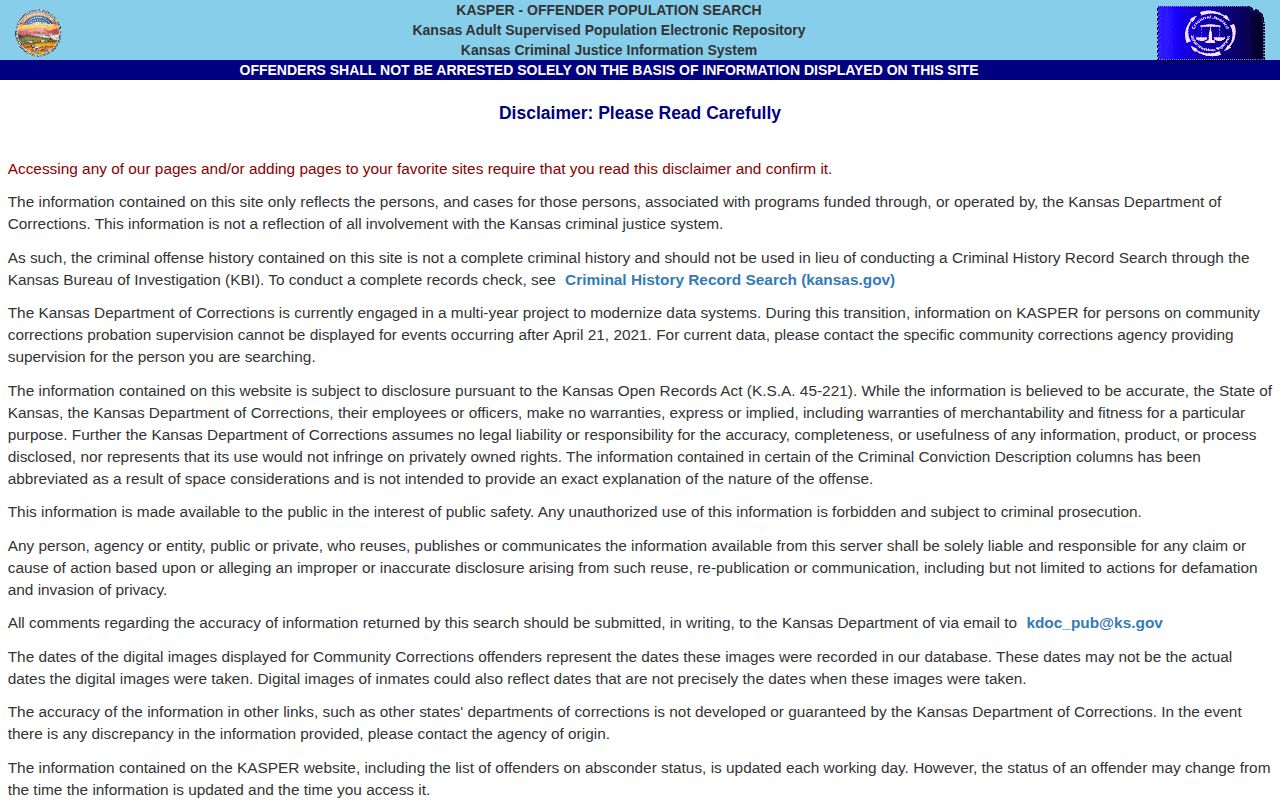
Search by name or KDOC number. Then read the profile as a whole: status, county or case, and photo details. A KASPER image is a corrections ID photo. The booking photo from the arresting county may differ. Completed sentences can leave a person listed as discharged. Removal can follow an overturned conviction, expungement, or executive clemency. The separate KDOC page walks through the profile fields, photo controls, and the records-request path.
Kansas Court Case Records
The Kansas Judicial Branch portal handles court cases, not jail rosters or booking photos. What you see varies by access rules. A case may show names, charges, docket entries, or documents. Nothing online does not mean no arrest happened. Sealed matters, juvenile cases, and protected documents carry their own limits. A clerk or a courthouse terminal may be the only route. The Judicial Branch's district court records access page lays out the public route. Its boundaries are mapped there too.
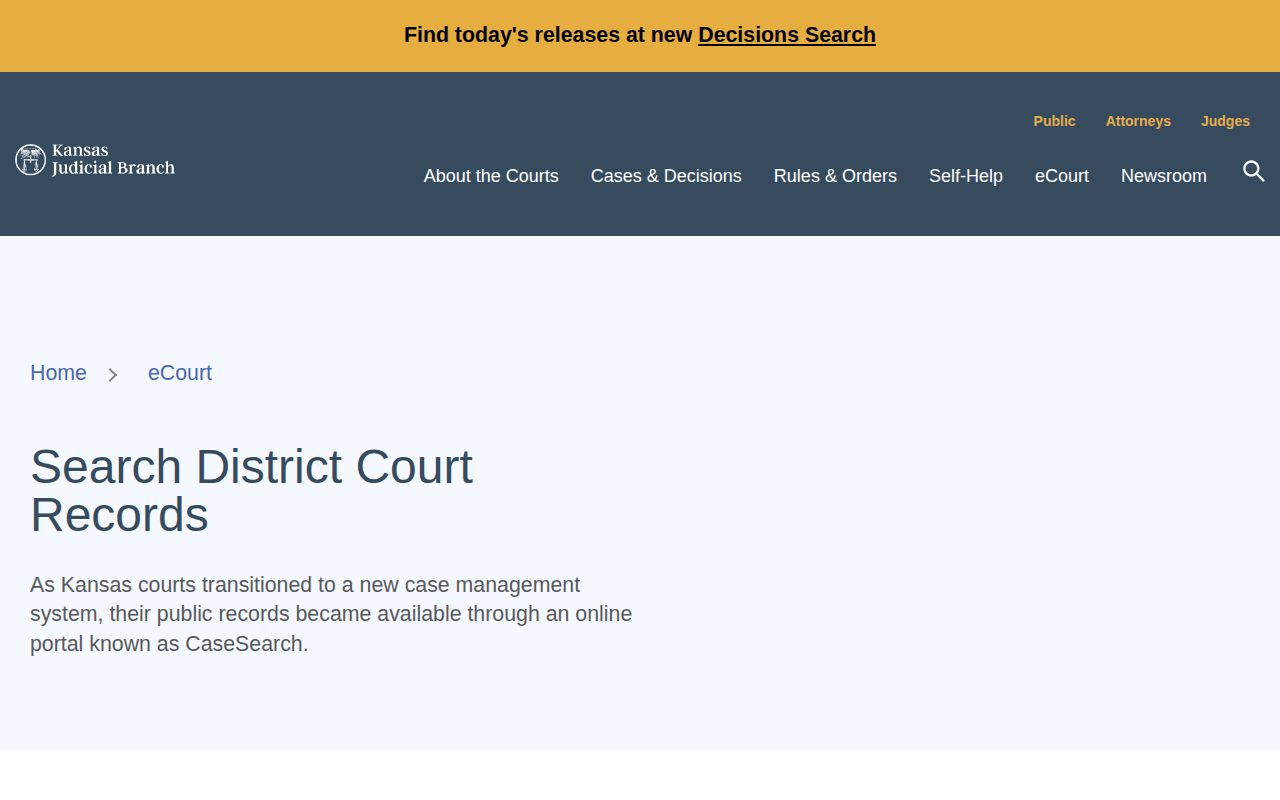
For later hearings, filed documents, and disposition, the court record is the authority. That holds wherever those items are public. Ask the clerk about anything the online portal does not reach.
Kansas Federal and Immigration Custody
Federal custody sits on a different map. The Bureau of Prisons locator finds federal inmates by name or register number. It is not a public federal mugshot gallery. Someone held in a county jail on a federal case may not have reached BOP yet, and a person out of BOP custody can still be held or supervised somewhere else. The official inmate locator runs the federal name or register-number search.
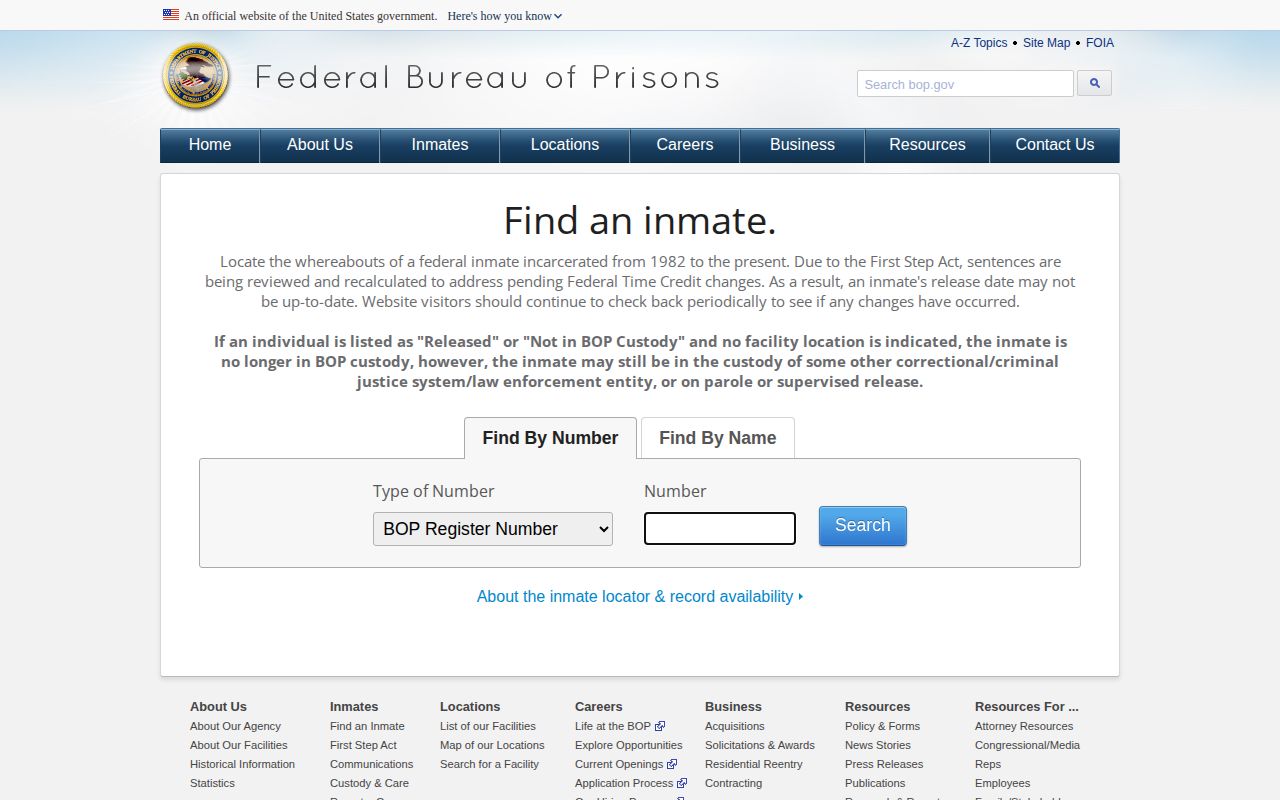
Check a federal result against its register number and custody details. The locator tracks current and historical BOP custody. It cannot flag every county-held person tied to a federal case.
ICE runs its own locator. It covers people currently in ICE custody plus some recently held by CBP. Timing gaps and missing records occur. You need an A-number paired with a country of birth, or exact biographical fields. The ICE detainee locator answers where someone is held. It does not promise a photo.
Kansas Wanted Lists and Warrants
A wanted-list entry is one agency's notice. No statewide warrant index exists behind it. The Kansas Bureau of Investigation picks who lands on its Most Wanted page. KDOC keeps separate parole and community-corrections absconder lists. The U.S. Marshals publish federal fugitive material. County sheriffs and courts may run their own active-warrant tools, and no single portal reaches every Kansas county.
For a possible Kansas tip, the KBI suspicious-activity page warns that online reports go unwatched overnight. Emergencies belong with 911 or local law enforcement.
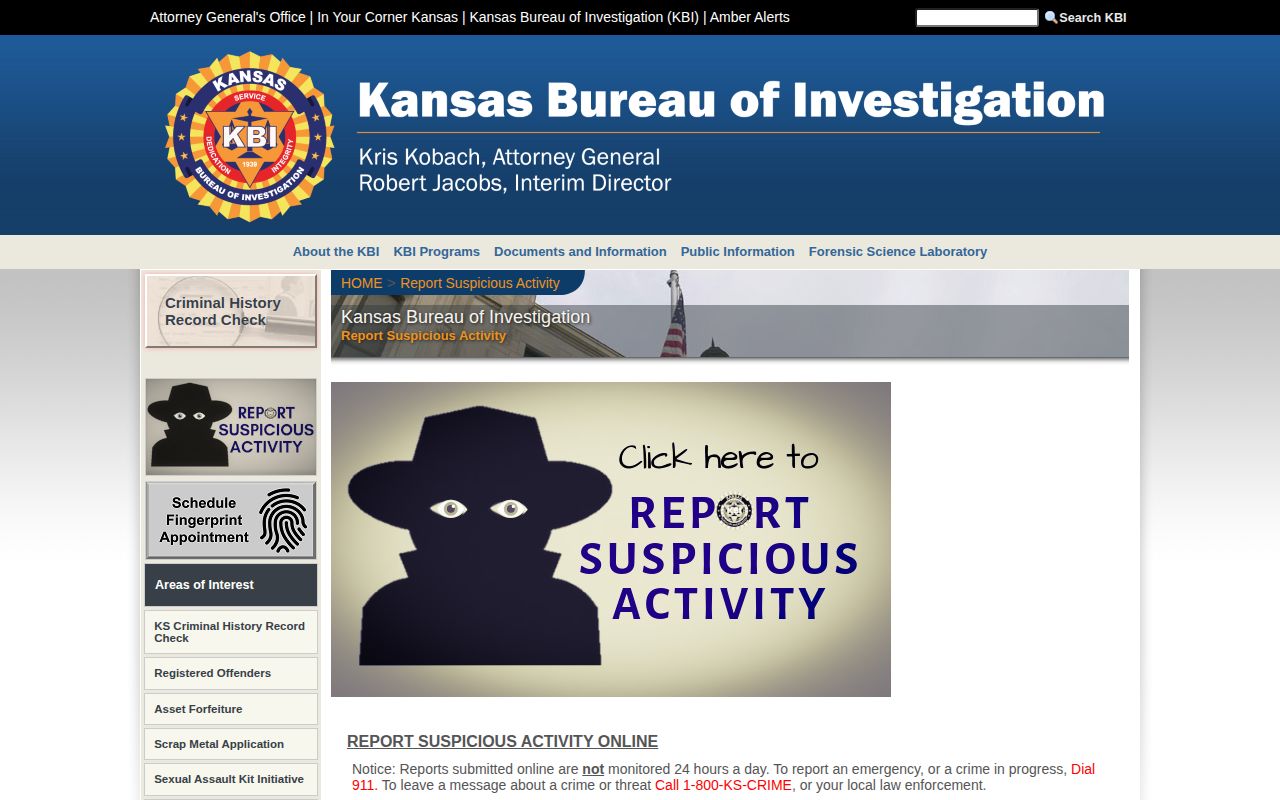
Checking a specific warrant takes a direct call. Contact the issuing court or the county law-enforcement office that holds the record. Confirm the result before acting. Warrants get recalled, served, or entered under a similar name. Never approach anyone on a list. The Kansas wanted fugitives page covers official list types, safer tip routes, and how to settle a warrant question with the responsible office.
Kansas Busted Records on Other Sites
Third-party pages can steer you toward an agency or a date. Their copied entries, though, may sit behind, repeat, or go stale. Always verify status and outcome with the official source.
Kansas newsrooms cover chosen cases, not a statewide feed. KSHB and The Kansas City Star have both described pulling back on routine booking photos, allowing exceptions for public safety or newsworthiness. Each publisher handles corrections differently. Treat a story or correction as a lead. The court record confirms the disposition.
What Follows a Kansas Busted Booking
These records track different moments in a case. A roster shows who is in a local jail right now. A booking record logs the intake itself. The court file then carries the outcome. That outcome might be a dismissal, diversion, acquittal, or conviction. Early on, an arraignment puts the charges in front of the judge. Bond sets the conditions for release while the case waits.
Where does the roster charge lead? Treat it as a starting point only. Charges can change once the case reaches court. The docket and the clerk's office hold the real answers about status.
A transfer can send a person from a county jail to state prison. It can also mean another county, federal custody, or immigration custody. Each of those systems updates on its own clock. A detainer concerns future custody rather than any court finding. When someone gets released, the live roster drops the name. The arresting agency still keeps its booking record on file.
Older photos survive in state archives, county files, court exhibits, and newspaper collections. A short roster window tells you nothing about official retention. The Historical Mugshots guide follows that archival trail.